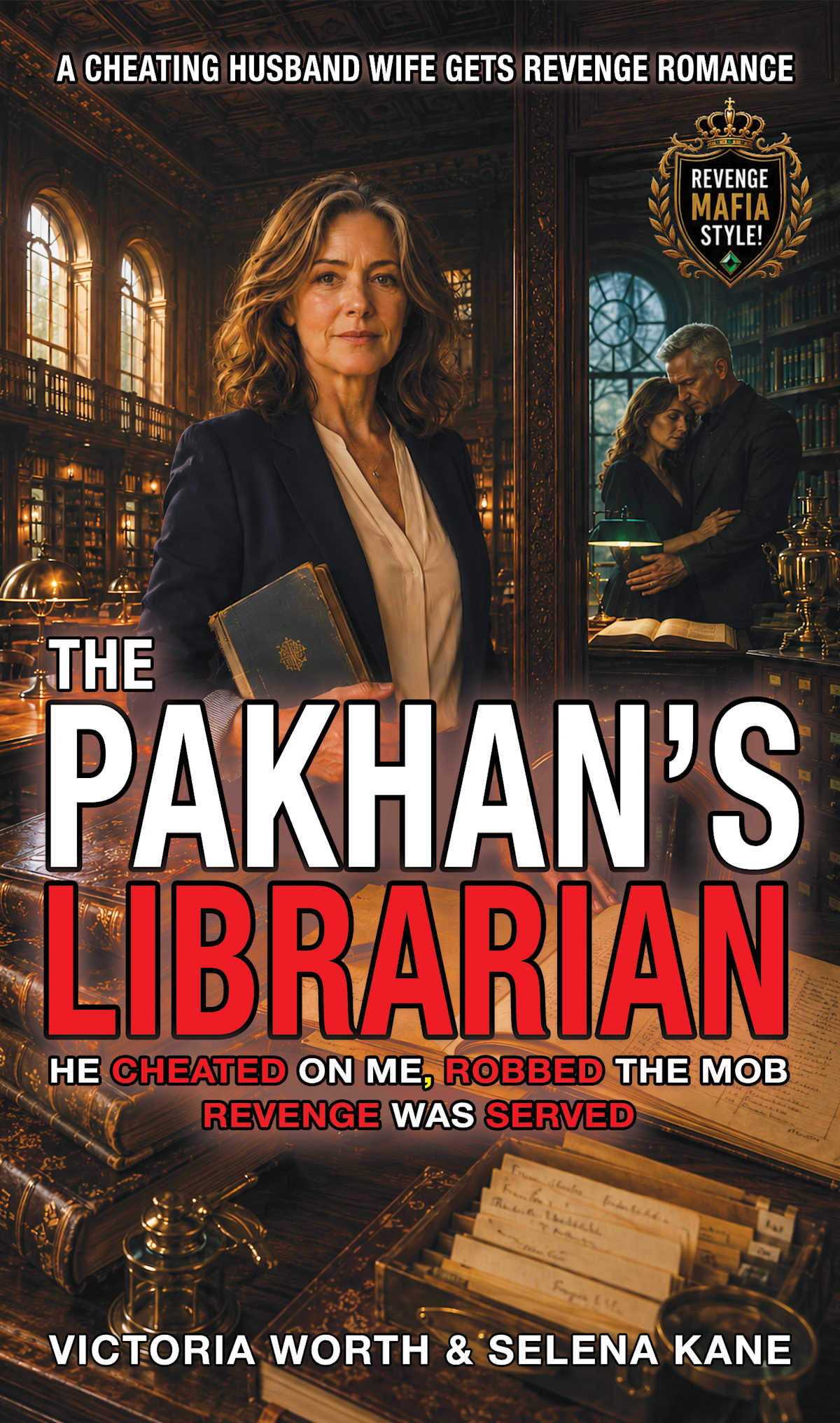
The Manuscript
A missing scene from The Pakhan's Librarian — the first meeting between Maggie and Aleksei, years before the novel opens.
I was thirty-nine the first time I met a man who collected truth the way other men collected paintings, though I didn't understand that about him until years later, standing in my own kitchen with a book I hadn't asked for.
At the time I only knew him as a client of Charles Pembroke's, a quiet man with a private library and a manuscript that needed a second opinion. My father had asked the favor as a favor, the way he did everything, gently and without much explanation, and I had said yes because saying yes to my father had never once cost me anything.
"He's careful with people," Charles told me on the phone the night before. "Careful the way I'm careful. You'll understand each other."
"You make him sound like a client of yours."
"He is a client of mine." A pause, brief enough that I nearly missed it. "Just be honest with him, Maggie. He values it more than most men do."
I remember thinking that was an odd thing to say about a book collector.
The house on Delancey Street gave nothing away from the sidewalk, federal brick, black shutters, a brass knocker gone soft with polish. A young man with a boxer's build let me in and said almost nothing, which I took at the time for shyness rather than what it actually was, a man who'd already decided I wasn't a threat and had nothing further to say about it.
The library occupied the whole of the third floor.
I had been inside a great many private collections by then, museum trustees, old Philadelphia families, the kind of book rooms built to be photographed rather than read. This was not that. The shelves ran floor to ceiling on every wall, crowded, worked, the spines showing the particular wear of books that had actually been opened. A cherry cabinet stood near the desk, its drawers labeled in a careful hand I didn't recognize yet as his own. The room smelled of leather, dust, and something underneath both, cedar, maybe, or pipe tobacco long since given up.
I have spent my whole professional life learning to read a room by its books, and this room told me its owner trusted almost nothing he hadn't verified himself.
He rose when I came in.
"Mrs. Ellsworth." He was tall, silver-haired, dressed the way a professor dresses for a lecture he's given forty times, comfortable, exact. Rimless glasses caught the lamp. "Thank you for coming."
"Margaret is fine."
"Margaret, then." He gestured to the desk, where a manuscript lay open beneath a cloth, and I understood, the way I always understand these things, that he had chosen the word Margaret deliberately, the way he seemed to choose everything, and had decided already that Maggie was a name for people who hadn't earned it yet.
Three folders sat beside the manuscript, each bearing a different appraiser's letterhead. I recognized two of the names. Serious people, careful people, the kind whose opinions rarely needed a second one.
"They agree," he said, watching me lift the cloth. "Late seventeenth century, devotional, likely monastic. A fine object, and a rare one."
"But you called me anyway."
"I called your father, who suggested you." He folded his hands. "I find that when three experts agree completely, it is worth paying a fourth to disagree with them, if she can."
I didn't answer that. I was already looking at the manuscript, and the manuscript had already stopped being polite conversation.
The vellum was good, old, consistent with the date on the three letterheads. The hand was right. The illumination in the margins had the slightly uneven gold leaf you'd expect from a monastery workshop rather than a court scriptorium, which argued for authenticity rather than against it. For the first several minutes I found nothing that disagreed with anyone.
Then I turned to the binding.
"May I?" I asked, and he nodded, and I opened the boards further than the three appraisers evidently had, because a first-rate binding discourages exactly that kind of curiosity, and a good conservator learns to be curious anyway.
The inner hinge told a different story than the vellum did.
"This has been rebound," I said. "Not recently. A hundred years ago, perhaps more. Someone took real care with it, matched the leather, matched the tooling, even matched the wear pattern along the spine. It's excellent work. It's also work that shouldn't exist on a manuscript this early, not unless someone wanted it to look older than it was."
The room went very quiet.
"The text itself may well be genuine," I went on, because stopping now felt like leaving a sentence half catalogued. "I think it probably is. But the binding is doing more work than a binding should. Someone wanted this object to read as more valuable, or more historically significant, than the plain, honest version of it would have been. I'd want the ink dated before I trusted the earliest date on any of these three letters."
I looked up, and understood, a half second too late, exactly what I'd just told a man in the middle of what appeared to be a very large purchase.
"I'm sorry," I said. "That isn't the answer you were hoping for."
"No," he agreed. "It is not."
I felt the old apology rising in my chest, the one I'd been offering my whole adult life for the crime of being right in a room where being right was inconvenient, and I opened my mouth to soften what I'd said, to hedge it, to give him some comfortable distance from the plain fact of it.
He spoke before I could.
"Most people, Margaret, tell me what I want to hear and call it an opinion." He removed his glasses, polished them on a handkerchief pulled from his breast pocket, unhurried, the way a man handles a thing he trusts more than most conversations. "You have just cost yourself a very large fee, and possibly my good opinion, and you did it in the first ten minutes, without once checking my face to see how I was taking it."
"I did check your face," I admitted. "I just didn't let it change what I said."
Something moved behind the rimless glasses that might, in a less careful man, have been the beginning of a smile.
"That," he said, "is the part that matters."
He asked me to write my findings formally, for his own records, and I did, standing at his desk while he watched me work the way I imagine he watched everything, without impatience, without hurry, cataloguing me the same way I'd just catalogued his manuscript. When I finished he read the page twice, folded it once, and set it inside the front cover of a different book entirely, a worn copy of Lermontov I hadn't noticed until then.
"You apologized," he said, "for telling me the truth."
"It's a habit."
"A bad one." He said it without unkindness, the way a man might note a hairline crack in a wall he intended to have repaired properly, someday, by someone with the patience for it. "Truth is not an imposition, Margaret. It is the only currency I have ever fully trusted. You'd do well to stop apologizing for spending it."
I didn't know, standing in that library at thirty-nine, what to do with a stranger who spoke to me as though my honesty were an asset rather than an inconvenience. I had a husband at home who had spent a decade teaching me the opposite lesson, patiently, kindly, in a hundred small corrections I hadn't yet learned to name. I only knew that something in the room had shifted, quietly, the way a well-cut hinge shifts a heavy door, and that I would think of this hour for longer than the manuscript itself deserved.
"Thank you," I said, "for asking a fourth opinion."
"Thank you," he said, "for giving me one worth having."
He walked me down through the quiet house himself, past shelves I hadn't had time to properly see, and at the door he paused with his hand on the latch.
"Rebinding a false history onto an honest object," he said, as though continuing a thought he'd been having in silence the whole way down the stairs. "It is a common crime. More common than people believe. The object survives it. It is only the provenance that suffers."
I have thought about that sentence more times than I can count in the years since, though it would be a long while yet before I understood he hadn't only been talking about the manuscript.
"Good evening, Margaret," he said, and shut the door behind me with the particular care of a man closing a book he intends to return to.
I didn't see him again for a long time. I didn't think about him often, not at first, not with a husband and a house and a life that kept both hands full.
But every so often, catching some rebound spine at the reading room desk that didn't quite match its own text block, I would hear his voice again, low and certain, telling me that truth was the only currency he had ever fully trusted.
I wonder now whether he already knew, that evening, what he'd find someday in my own provenance, the false binding wrapped around an honest woman, holding its shape for twenty-seven years because no one had ever thought to open the hinge.
He always did prefer to look closer than three experts thought was necessary.
To continue reading the series
-------------------------------------------
Thank you for reading! I hope you enjoyed the characters, story, and twists! If so, you might want to give my short book, No Witness for My Cheating Husband, a try. It’s FREE when you sign up to join my email reader club!
My cheating husband needed my notary stamp to fund his mistress.
Too bad I’m the witness he should have feared.
On Tuesday afternoon, I watched an elderly woman sign a power of attorney with a shaking hand.
On Tuesday night, my husband handed me a felony over steak and red wine.
He called it a favor. A refinance document with his business partner’s signature. One tiny stamp from his notary wife so the deal could close on time.
But I don’t stamp favors.
I witness signatures. I record names. I keep a journal the law already trusts.
At first, I thought my husband was trying to steal from his business partner.
Then I found the money. And the mistress.
He thought I’d be a good wife. He thought I’d look away.
He thought wrong.
For readers who love: cheating husband revenge, mistress-funded fraud, forged documents, wife gathers evidence, notary journal payback, financial betrayal, no reconciliation, and justice served cold.
Download No Witness for My Cheating Husband for free when you click here to join my reader club!